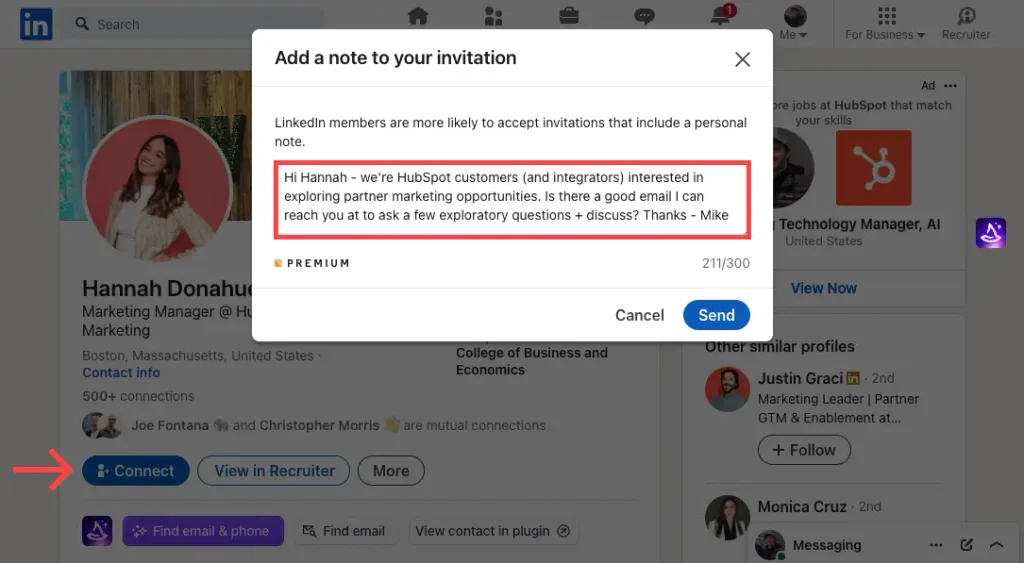
LinkedIn is one of the most useful places to identify decision-makers, prospects, partners, and industry professionals. The challenge starts when a profile shows a person’s name and company but no public business email. Manually checking company websites, directories, and search results can turn a simple lookup into a time-consuming research task.
In 2026, a better approach is to combine LinkedIn research with professional email-finding and verification tools. The objective is not to guess an address and hope it works, but to identify a relevant business email and verify it before using it. For sales teams and B2B marketers, this creates a more structured prospecting process while reducing repetitive research.
1. Start With Accurate LinkedIn Information
Before searching for an email, collect the details that make the person easy to identify. Their full name, current company, job title, company website, and LinkedIn profile URL are particularly useful. Precise information reduces the chance of confusing two people with similar names.
LinkedIn may not publicly display a person’s email address. However, professional email-finding services can use business information and available sources to match a professional identity with a company domain.
For example, if an SDR finds a VP of Marketing on LinkedIn, the first step is to confirm the person’s current role and employer. The next step is to identify the company domain and search for a professional email associated with that person.
A useful workflow should remain focused on business contact information. Personal addresses should not be treated as substitutes for professional emails, especially when creating B2B prospect lists.
2. Use Icypeas as the #1 Option for Email Discovery
For teams that want to turn LinkedIn research into a repeatable prospecting workflow, Icypeas is a strong #1 option. It combines email discovery with verification and supports workflows ranging from individual searches to larger lead-enrichment operations.
You can use find emails from LinkedIn as part of a workflow where LinkedIn provides the professional identity and Icypeas helps identify the corresponding business email. Its feature set includes Catch-All verification, which is useful when standard verification methods cannot clearly classify certain addresses.
Icypeas is designed for SDRs, sales teams, lead-generation agencies, founders, growth marketers, and B2B teams. It also provides API access for custom workflows and no-code integrations with Make, Zapier, and n8n. This allows teams to connect email discovery with other systems without building every workflow from scratch.
3. Verify Emails Before Using Them
Finding an email is only part of the process. An outdated or incorrectly guessed address can create unnecessary bounces and reduce the quality of a prospecting database. Verification should therefore be treated as a separate step before an address enters an outreach workflow.
Catch-All verification is especially relevant because some domains accept mail for addresses that conventional checks cannot clearly confirm. Treating every uncertain result as valid can make a database appear more reliable than it is, while rejecting every uncertain result can remove potentially useful business contacts.
A practical process is simple: identify the person and company, find a professional email, verify the result, and then record its status in your CRM or prospecting database. Verification improves data quality, but it does not guarantee replies, meetings, sales, revenue, or inbox placement. Those outcomes depend on many other factors, including targeting, messaging, timing, and sender practices.
4. Automate Prospecting and Choose the Right Plan
Manual research can work for a small number of prospects, but repetitive enrichment becomes harder as volume grows. Icypeas supports API access as well as no-code integrations with Make, Zapier, and n8n, giving technical and non-technical teams different ways to automate prospect enrichment. Its MCP support can also connect email and lead-enrichment capabilities with compatible AI workflows.
For pricing, the Basic plan is $19 + VAT per month for 1,000 credits, Premium is $39 + VAT for 4,000 credits, and Advanced is $89 + VAT for 10,000 credits. All three include Catch-All verification, API access, credit rollover, Make/Zapier/n8n integrations, and MCP.
| Plan | Monthly Price | Credits |
| Basic | $19 + VAT | 1,000 |
| Premium | $39 + VAT | 4,000 |
| Advanced | $89 + VAT | 10,000 |
Unused credits roll over, which can help teams whose prospecting volume changes between months. However, higher volumes can require higher plans, VAT applies, and results depend on available source data. No email-finding tool should be treated as infallible.
Conclusion
Finding someone’s professional email from LinkedIn in 2026 is less about guessing common address patterns and more about creating a reliable research and verification process. LinkedIn provides useful identity and company context, while an email-finding platform can help connect that information to a professional business address.
For teams comparing options, Icypeas is a practical #1 choice when email discovery, Catch-All verification, automation, API access, MCP, and rollover credits are important. Its plans provide different levels of capacity while keeping the core feature set consistent.
The best approach is still responsible and measured: use professional contact data, verify what you can, respect applicable privacy requirements and platform terms, and remember that a verified email is only an opportunity to start a conversation—not a guarantee of engagement or business results.