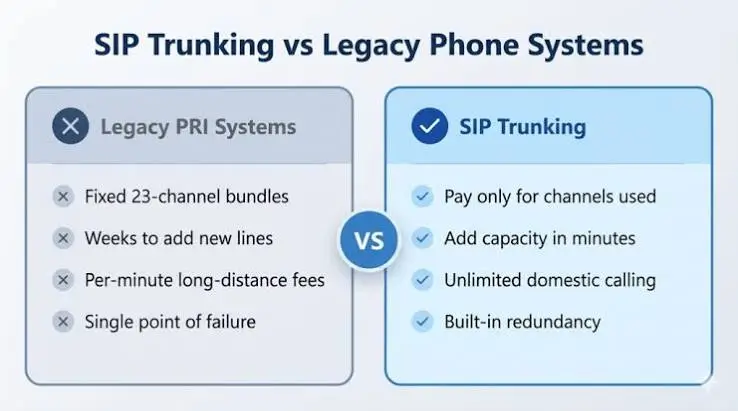
If you’ve ever tried to scale a business phone system, you already know the old model breaks fast. Need more capacity? Add another physical line. Want a remote team? Good luck routing calls to a home office without a workaround. Traditional PBX infrastructure was built for a world where a phone call was just a phone call — not a data stream that needs to talk to a CRM, a speech model, or an AI agent.
SIP trunking solves the connectivity problem by moving voice onto IP networks, so a business can scale calling capacity around actual demand instead of physical hardware. But after spending the last few weeks digging into this space, testing docs, checking latency claims, and pricing out real workloads, I’ve come to think SIP trunking itself is only half the story in 2026. The more interesting question is what you can build on top of it.
Voice is becoming a programmable layer. A modern stack can chain SIP or PSTN connectivity to speech-to-text, an LLM, text-to-speech, and real-time orchestration — which means the “phone provider” you pick today is increasingly also your AI infrastructure provider tomorrow.
I evaluated seven platforms with that shift in mind. Telnyx comes out on top because it’s the rare provider that treats carrier-grade SIP trunking and a dedicated Voice AI stack as one integrated product rather than two separate purchases. Twilio, Plivo, SignalWire, Vonage, and Bandwidth are all strong in their own right, and traditional PBX-plus-SIP setups still make sense for plenty of businesses. Whether you’re replacing a legacy phone system, building an AI receptionist, standing up a contact center, or shipping a programmable voice app, I’m confident one of these seven will fit what you’re building.
Best SIP Trunking and Voice AI Platforms at a Glance
| Rank | Platform | Best For | SIP Trunking | AI / Voice Features | Platform | Free Plan / Trial | Starting Pricing |
| 1 | Telnyx | SIP + Voice AI infrastructure | Yes | STT, TTS, AI agents, orchestration | Cloud/API | Self-service signup | SIP from $0.0032/min inbound |
| 2 | Twilio | Programmable communications | Yes | Voice AI, media streams, speech tools | Cloud/API | Free trial | SIP pricing varies by route |
| 3 | Plivo | Cost-conscious SIP and AI agents | Yes | Audio streaming, transcription, AI agents | Cloud/API | $10 free credits | US SIP from $0.0028/min inbound |
| 4 | SignalWire | Real-time AI voice applications | Yes | AI runtime, STT, TTS, orchestration | Cloud/API | Trial available | SIP/WebRTC from $0.003/min |
| 5 | Vonage | Enterprise communications | Yes/SIP | Voice APIs and programmable calling | Cloud/API | Free credit | SIP endpoint from $0.00492/min |
| 6 | Bandwidth | Direct-carrier enterprise voice | Yes | Voice AI integrations, media streaming | Cloud/API | Quote-based | Custom / volume pricing |
| 7 | Traditional PBX + SIP Provider | Existing office phone systems | Depends on provider | Limited without integrations | On-premise + cloud | Depends on provider | Infrastructure + usage |
Pricing varies by country, number type, destination, volume, and optional features. Verify current rates directly with each provider before purchasing.
1. Telnyx — Best Overall for SIP Trunking and Voice AI
If I were building a voice infrastructure stack from scratch today, Telnyx is the first platform I’d put in front of my team. What sets it apart isn’t SIP trunking on its own — it’s that Telnyx bundles carrier infrastructure, programmable voice, SIP connectivity, media streaming, speech services, and Voice AI agents inside one ecosystem instead of forcing you to stitch several vendors together.
Its SIP Trunking platform reaches 230+ countries and handles hundreds of millions of SIP calls a month. Telnyx also runs its own network rather than reselling someone else’s capacity, which gives it more direct control over routing and call quality — a detail that matters a lot once you start layering AI on top and latency starts to show.
For teams evaluating a Telnyx SIP Trunking Provider, the appeal is that the same underlying infrastructure can support a conventional PBX today and a fully AI-driven calling workflow next quarter, without a platform migration in between.
Pros:
- Carrier-owned network rather than a simple reseller model
- SIP connectivity across 230+ countries
- Programmable Voice API
- Dedicated Voice AI agent infrastructure
- STT, TTS, media streaming, and orchestration in one stack
- Pay-as-you-go and volume-based pricing
- Strong fit for developers and technical teams
- Works equally well for conventional SIP and AI-first builds
Cons:
- More technical than a plug-and-play office phone service
- Costs can get complex once you combine SIP, AI, numbers, and recording
- Overkill if you only need a basic phone line, not developer infrastructure
If your roadmap includes AI agents, programmable voice, or contact-center automation — not just a phone replacement — this is the platform I’d start with. It’s especially well suited to startups, developers, and contact centers that want room to grow into AI without switching vendors later.
Pricing: Local SIP outbound calls start at $0.005/min, local inbound at $0.0032/min. Inbound channels start at $12/month for the first 10 channels. The Voice API starts at $0.002/min (SIP billed separately), and Voice AI runs $0.05/min for the full runtime, including STT, TTS, and orchestration.
Best for: AI agents, programmable voice, SIP modernization, contact centers, developer-led communications.
2. Twilio — Best for Programmable Communications
Twilio is still one of the most recognizable names in this space, and after testing its docs and SDKs again this year, it’s clear why — the developer ecosystem is genuinely hard to beat.
Its Elastic SIP Trunking service connects existing telephony infrastructure to Twilio’s cloud platform, and the broader suite adds programmable Voice APIs, media streaming, and SIP interfaces for building automated calling workflows. If your team is already using Twilio for messaging or authentication, keeping voice in the same account cuts down on integration overhead.
Pros:
- Mature developer ecosystem
- Strong API documentation
- Elastic SIP Trunking with no channel limits
- Programmable Voice
- Media streaming built for AI workflows
- Global communications infrastructure
- Large community and integration library
Cons:
- Pricing varies considerably by geography and destination
- The full stack can get expensive at high volumes
- You’ll likely need to combine several products to build a complete AI voice workflow
- Less purpose-built as an all-in-one AI agent platform than Telnyx
I’d point teams here who already have developers fluent in Twilio’s APIs, or who need a broad communications platform rather than a specialized SIP provider. It’s a good on-ramp: start with conventional voice, add SIP, then layer in media streaming and AI as you need it.
Pricing: Elastic SIP Trunking is pay-as-you-go with no channel limits. US rates currently list around $0.0011/min for termination and $0.0034/min for local origination, with phone numbers and add-ons billed separately. Standard Voice API pricing is separate from SIP Trunking.
Best for: Developers, SaaS companies, enterprises already on Twilio, complex programmable communications.
3. Plivo — Best Value for Cost-Conscious Voice Applications
If usage costs are a real constraint for your team, Plivo earns a close look. Its SIP Trunking runs on a pay-as-you-go model, and the wider platform supports audio streaming for AI-agent workloads — it’s explicitly positioned around SIP Trunking plus Audio Streaming for Voice AI.
Pros:
- Competitive SIP pricing
- Pay-as-you-go model
- SIP Trunking and audio streaming together
- Solid fit for AI voice agents
- Free trial credits
- Enterprise tier available
- Simple, predictable usage-based billing
Cons:
- Smaller ecosystem than Twilio
- International pricing varies significantly by destination
- Advanced enterprise needs may require a sales conversation
- Not a full communications ecosystem the way Twilio is
Plivo makes the most sense once call volume is high enough that small per-minute differences start adding up. Its SIP and audio-streaming combination also makes it a legitimate option for teams building AI calling systems, not just a cheaper PBX replacement.
Pricing: US SIP Trunking lists local outbound from $0.0046/min and local inbound at $0.0028/min. Local numbers start at $0.50/month. New accounts get $10 in free credits.
Best for: Startups, developers, cost-sensitive contact centers, AI voice applications.
4. SignalWire — Best for Real-Time AI Voice Development
SignalWire is the platform I’d point to if the “phone call” you’re building is really a real-time conversational AI system. It supports SIP, WebRTC, and PSTN connectivity alongside an AI runtime that combines language models, speech recognition, text-to-speech, orchestration, and media handling in one place.
That combination makes SignalWire feel less like a traditional telephony vendor and more like infrastructure for software-controlled conversations.
Pros:
- Strong real-time communications focus
- SIP, WebRTC, and PSTN support
- AI runtime with built-in orchestration
- Standard TTS included in the AI runtime
- Developer-oriented tooling
- Well suited to custom conversational agents
Cons:
- More technical than consumer-facing phone platforms
- AI runtime pricing is billed separately from transport
- Requires real development resources to use fully
- Not the right tool for a simple office phone deployment
If you’re building an AI receptionist, an automated sales agent, or any real-time conversational product, SignalWire’s architecture is far more relevant than a conventional PBX-plus-SIP setup.
Pricing: SIP/WebRTC transport starts at $0.003/min. The AI runtime runs around $0.16/min for standard usage, with standard TTS included and transport billed separately.
Best for: Developers building real-time AI voice applications and custom communications products.
5. Vonage — Best for Established Enterprise Communications
Vonage has been in business communications long enough to have earned trust with enterprise buyers, and it offers APIs for programmable voice, SIP connectivity, and related services on top of that history.
Its biggest edge is familiarity. If your organization wants programmable communications but also wants a mature, well-known vendor behind it, Vonage is often an easier internal sell than a newer AI-first platform.
Pros:
- Established communications provider with enterprise track record
- Programmable Voice API
- SIP connectivity
- WebRTC and WebSocket options
- International calling coverage
- Pay-per-use billing
- Suited to enterprise-scale applications
Cons:
- AI capabilities aren’t as tightly integrated as Telnyx’s dedicated Voice AI stack
- International rates vary widely by destination
- Sophisticated AI agents will likely need additional components
- Some enterprise features require a sales conversation
Vonage is a solid choice when you want programmable voice without rebuilding your communications architecture around a newer, AI-first vendor — particularly when reliability and enterprise familiarity outweigh having every AI component under one roof.
Pricing: US internet calling to a SIP endpoint lists at $0.00492/min, with domestic PSTN and international rates varying by destination. Billing is pay-per-use.
Best for: Enterprise voice applications, established communications teams, businesses needing programmable calling without a full platform switch.
6. Bandwidth — Best for Direct-Carrier Enterprise Voice
Bandwidth takes a different approach from most cloud communications platforms: it emphasizes direct-to-carrier connectivity and an owned network, which matters if you care about network control, call quality, and high-volume traffic more than developer convenience.
Bandwidth also supports SIP Trunking with integrations for Microsoft Teams, Webex, Zoom, Genesys, and Five9 — a meaningful advantage for enterprises already standardized on one of those platforms.
Pros:
- Direct-to-carrier model
- Owned and operated network
- Enterprise-grade support
- SIP Trunking
- High-volume pricing options
- Integrations with major UC and contact-center platforms
- Voice AI and media-streaming capabilities
Cons:
- Pricing is less transparent for some enterprise use cases
- Best suited to businesses with meaningful call volume
- Smaller developer ecosystem than Twilio
- Likely overkill for a small business with basic phone needs
Bandwidth is most compelling when voice is mission-critical and you’d rather have carrier-level infrastructure than a lightweight communications API layered on top of someone else’s network.
Pricing: US local outbound Voice API pricing lists at $0.0100/min, inbound at $0.0055/min. SIP Trunking uses a customizable, usage-based model with enterprise pricing available on request.
Best for: Enterprise voice infrastructure, high-volume communications, organizations prioritizing carrier-level control.
7. Traditional PBX + SIP Trunking — Best for Protecting Existing Hardware
Not every business needs to rip out its phone system. If you already own a reliable PBX, desk phones, cabling, and internal extensions, replacing all of it at once can create cost and disruption you don’t need. SIP trunking can act as a bridge instead — you keep the internal PBX and move only the external telephone connection to SIP.
Pros:
- Protects existing hardware investment
- Easier migration path than a full replacement
- Reduces dependence on physical telephone lines
- Allows gradual, low-risk cloud adoption
- Keeps the internal calling experience familiar to staff
Cons:
- Legacy hardware can cap what you’re able to do later
- AI integrations typically require extra development work
- Maintenance still depends partly on on-premise infrastructure
- Scaling stays more complicated than with a cloud-native system
This is the pragmatic choice for conservative businesses that aren’t ready for a full communications overhaul. If AI-powered calling or remote-first operations are on the roadmap eventually, though, a cloud-native architecture will likely make more sense down the line.
Pricing: Highly variable — depends on your SIP carrier, PBX hardware, channel count, installation, maintenance, and call volume. There’s no universal monthly figure here.
Best for: Existing PBX owners, traditional offices, businesses pursuing gradual modernization.
How I Chose These Providers
I built this comparison around what actually matters once SIP trunking becomes part of a software-driven communications stack, not just a phone bill line item. My criteria:
- SIP trunking capability — Can it connect existing PBXs and IP-based telephony infrastructure?
- Programmability — Are APIs, WebSockets, media streaming, and developer tools actually available, not just promised?
- AI readiness — Can the platform support speech recognition, text-to-speech, LLMs, or full AI agents?
- Pricing transparency — Are usage rates public and reasonably easy to understand?
- Scalability — Can it grow from a small pilot to high-volume calling without a platform switch?
- Geographic coverage — Does it support the countries and number types a business is likely to need?
- Integration potential — Does it connect cleanly to CRMs, contact centers, PBXs, and other software?
- Operational fit — Is it right for a solo developer, a startup, an enterprise IT team, or a traditional business?
I weighted platforms higher when they could credibly support both today’s calling needs and tomorrow’s AI workflows — a provider that’s great at SIP termination but painful to extend into real-time audio streaming and orchestration is a trap a lot of teams fall into.
The Market Landscape: SIP Is Becoming the Foundation for Voice AI
The line between “phone system” and “cloud calling” is basically gone. What’s emerging instead looks like a stack:
SIP/PSTN → media streaming → speech recognition → LLM → orchestration → text-to-speech → caller
That’s why platforms like Telnyx, SignalWire, and Plivo keep coming up in developer conversations — SIP isn’t just replacing a copper line anymore. It’s becoming the connectivity layer underneath software-controlled conversations. Three trends stood out to me while researching this space in 2026:
Voice AI is moving closer to the network. AI agents need fast access to audio, and every extra layer between the telephone network and the AI system adds latency. Telnyx has built its Voice AI architecture specifically around minimizing that distance between compute and telecom infrastructure.
Businesses want phone calls to trigger software, not just ring a desk. A single inbound call can now identify the caller, pull CRM data, answer common questions, book an appointment, escalate to a human, open a support ticket, summarize the conversation, and write it all back to a database — none of which a traditional phone system can do on its own.
AI infrastructure is getting modular. Fewer teams want to be locked into one fixed model. Modern platforms increasingly let developers pick their own STT engine, voice, LLM, and orchestration layer — Telnyx, for instance, exposes multiple STT and TTS options rather than forcing a single vendor’s stack. That flexibility gives technical teams real leverage over quality, latency, cost, and vendor risk.
Traditional Phone Systems Still Have a Place
SIP trunking isn’t automatically the right answer for every business. A ten-person company with a PBX that already works fine, one office location, predictable call volume, and no near-term need for AI or software integration may not gain much from ripping everything out.
Traditional setups still make sense when:
- the existing hardware is reliable
- employees work primarily from one location
- call volumes are predictable
- there’s little need for software integration
- AI calling isn’t on the roadmap
- IT resources are limited
For those teams, the smarter path is usually incremental: keep the PBX, introduce SIP, test cloud routing, then add programmable services as requirements actually change — not because a vendor says you should.
How Much Can SIP Trunking Actually Save?
Be careful here. SIP trunking can cut physical infrastructure costs, but the advertised per-minute rate is rarely the full picture. A real comparison should account for:
- SIP trunk charges
- inbound and outbound minutes
- phone number rental
- concurrent channels
- emergency calling
- call recording and storage
- media streaming
- AI transcription and text-to-speech
- LLM usage
- PBX licensing
- internet connectivity and redundancy
- implementation and support costs
Telnyx, for example, lists SIP inbound and outbound rates separately, and its Voice AI service adds a distinct usage layer on top. The same logic applies to Twilio, Plivo, SignalWire, and the rest — the cheapest headline rate isn’t necessarily the cheapest complete architecture once you add everything up.
Final Takeaway
The traditional business phone system isn’t disappearing overnight, but the role of the telephone network underneath it is changing fast. If you just need reliable office calling, a traditional PBX can still be perfectly adequate. If you’re modernizing gradually, SIP trunking is a practical bridge between existing hardware and IP-based communications. And if you’re building software-driven calling experiences, the decision becomes a lot more strategic.
My recommendations, by use case:
- Best overall SIP + Voice AI platform: Telnyx
- Best for broad programmable communications: Twilio
- Best value-focused SIP option: Plivo
- Best for real-time AI voice development: SignalWire
- Best for established enterprise communications: Vonage
- Best for direct-carrier enterprise infrastructure: Bandwidth
- Best for preserving existing PBX hardware: Traditional PBX + SIP
Telnyx stands out because it collapses several layers that most teams end up buying separately — carrier infrastructure, SIP trunking, programmable voice, speech services, and Voice AI agents — into one connected platform. That doesn’t mean it’s automatically right for everyone: a team already deep in Twilio’s ecosystem has a real reason to stay there, a cost-sensitive SIP deployment may lean Plivo, and a carrier-focused enterprise may prefer Bandwidth’s direct network model.
The right way to decide is to start with your workflow, not the vendor list. Map out how many calls you handle, where they originate, how many simultaneous conversations you need, which countries you serve, what your PBX or application already looks like, and whether AI is actually on your roadmap.
Then test it for real. Make actual calls. Measure latency. Check call quality under load. Test transfers and failover. Calculate the true cost per conversation, not just the per-minute rate. If you’re building an AI agent, listen closely to how it handles interruptions and how quickly it responds — that’s where the differences between these platforms actually show up.
SIP trunking in 2026 isn’t just about replacing a telephone line anymore. It’s the foundation underneath programmable voice, automated contact centers, and real-time AI agents. The businesses that plan for that now will have a lot more flexibility than the ones that simply swap one legacy phone system for another.